Executive Summary
Let’s be honest. More never meant better.
More leads. More tools. More analytics. More research. More reports. More meetings. More everything — except actual conversations with your prospects. The profession that was built on the power of human connection has been quietly buried under an avalanche of administration. You are not losing deals because you lack skill. You are losing time — and time is exactly what deals are made of.
We know this because we have lived it. The2Guys was built by former sales professionals who spent years in the same cycle: arriving at meetings under-researched, sending emails that should have been more specific, following up with content that should have been ready days earlier. We experienced firsthand how much of the working week is consumed by tasks that are necessary but do not generate revenue — and how much that structural imbalance costs in missed quota, lost deals, and unrealised potential.
So we built Sales Narrator.
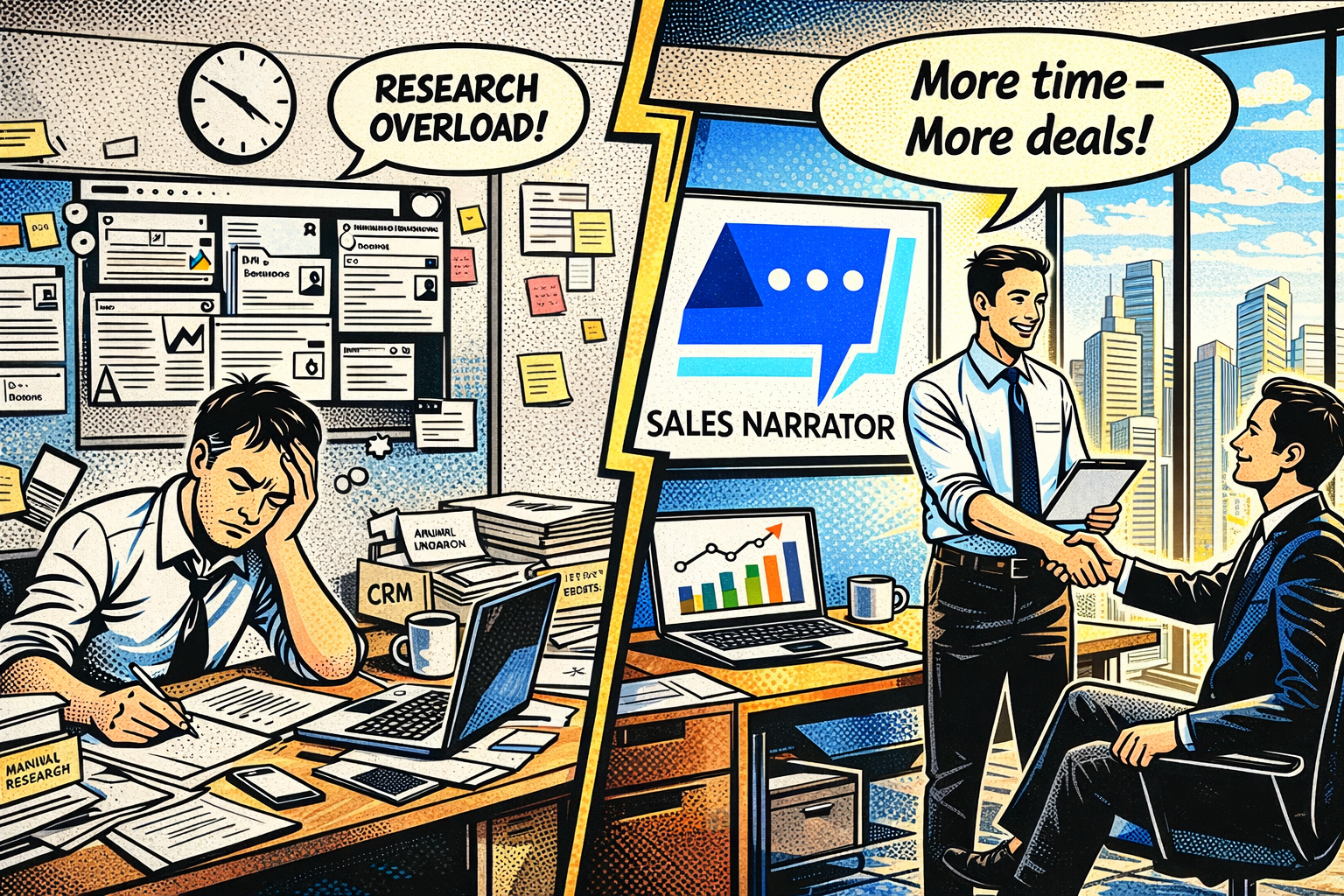
Sales Narrator is an AI-powered sales intelligence and content platform that gives back, on average, 30 percent of your selling time. The math is simple and the impact is immediate: today you spend 70 percent of your week on administration and preparation, and 30 percent actually selling. With Sales Narrator, that shifts to 40 percent administration and 60 percent selling. We double your available selling time — and maximise the quality of every engagement with highly personalised content built from your prospect’s own intelligence.
More time. More deals.
| 72% of sales rep time spent on non-selling tasks (Salesforce) | 70% of B2B reps missed quota in 2024 |
| 8–12% email response rate vs. 1–3% industry average | 117% revenue increase per rep |
1. The Problem Every Sales Professional Recognizes
1.1 70% of Your Time Is Spent Not Selling
You already know this. You do not need a research report to feel it — you feel it every Monday morning when you look at your week and see how little of it is actually yours. But the data confirms what you know: B2B sales professionals spend only 28 to 33 percent of their working time in active selling — prospecting, meeting with buyers, advancing opportunities, closing. The rest is consumed by:
- Research and prospect analysis: 3+ hours per new prospect, manually assembled from LinkedIn, company websites, press releases, and financial disclosures — before a single conversation has taken place.
- Content creation: 2 to 4 hours per email sequence, proposal, presentation, or follow-up document — written from scratch, every time, for every account.
- CRM administration and updates: 1 to 2 hours daily, logging interactions, updating fields, maintaining pipeline hygiene.
- Internal coordination: briefing technical consultants, preparing deal reviews, chasing marketing for content, escalating to leadership.
- Searching for the right contact: salespeople spend up to 40 percent of their time simply identifying who to call.
You are working long hours — often 40 to 60 hours a week — and still struggling to hit quota. Not because you lack effort. Because the system you work in is structurally misaligned: the tasks that consume the majority of your hours are the ones least directly connected to revenue.
1.2 Less Time = Less Deals. Yet You Still Have to Deliver.
The consequence of that time misallocation is not abstract. In 2024, 70 percent of B2B sales reps missed quota. Average attainment across B2B organizations was around 47 percent of target. For Enterprise Account Executives specifically — the hunters responsible for new-logo business — the figure was just 38 percent.
| Role | Average Quota Attainment 2024 |
| Enterprise Account Executive | ~38% |
| Mid-Market Account Executive | ~40% |
| Account Manager (renewals/expansion) | ~50% |
| Sales Development Representative | ~53% |
Notice the pattern. Account managers handling renewals — where relationship context and account intelligence already exist — consistently outperform hunters. The advantage is not effort. It is preparation. Knowing your account deeply gives you the edge that drives attainment. The structural deficit that hunters face is precisely the information and context advantage that Sales Narrator provides — systematically, for every account, from the first touch.
Meanwhile, quotas rose approximately 37 percent in 2024 compared to 2023. More pressure. Same hours. Same preparation constraints. The gap between what is expected and what is achievable without systematic support has never been wider.
1.3 Your Buyers Know You Before You Know Them. Do You Know Them?
B2B buyers complete more than 70 percent of their purchase journey before they ever speak to a sales representative. By the time they engage you, they have researched your company, compared your competitors, and formed a view. They arrive with a shortlist — and the vendor already on that shortlist wins the deal approximately 78.5 percent of the time.
In the compressed window you are given — buyers spend only around 17 percent of their total purchasing time across all vendors combined — what matters is not your product features. It is whether you demonstrate that you have done the same depth of research on them that they have done on you. That you understand their business, their strategic priorities, their pressures, and the specific context that makes your solution relevant to them right now.
Knowing them better than themselves is not an aspiration. It is the price of admission. Generic outreach signals the absence of preparation. In a market where buyers arrive pre-informed and time-pressured, that signal is disqualifying.
2. What Changes When You Use Sales Narrator
Before explaining how Sales Narrator works, it is worth being direct about what it changes for you as a sales professional. The explanatory detail that follows will make more sense once you have seen the outcome.
Sales Narrator is not a research tool that happens to write emails. It is not a template library with AI-flavoured automation. It is a platform that repositions how your week is spent — moving you from 70/30 to 60/40, from preparation-heavy to conversation-heavy, from reactive to genuinely ahead of your deals.
2.1 More Time
Every hour currently spent on manual research, content creation, and CRM administration is an hour not spent in conversation with a prospect. Sales Narrator gives those hours back:
- Prospect research that takes 3–5 hours manually: done in under 5 minutes.
- Introduction and follow-up emails that take 20–45 minutes to write: generated in seconds.
- Meeting preparation with structured stakeholder intelligence: ready in under 10 minutes.
- Tailored presentations per account: generated in 30 to 90 seconds.
- White papers and capability documents: generated in under 60 seconds.
- Full prospect intelligence package — research, executive profiles, talking points, first email: under 15 minutes per prospect.
2.2 Better Intelligence
The research Sales Narrator produces is not a summary of what you could have found in three hours of manual searching. It is a structured, layered intelligence profile that synthesises company strategy, financial signals, sector dynamics, executive priorities, and competitive context — drawing from sources you would never have time to consult individually. The result is that you walk into every conversation knowing your prospect’s business better than most of their competitors do. In many cases, better than they expect you to.
2.3 Better Conversations
The intelligence you carry into a meeting determines the quality of the conversation you can have. When you reference a specific initiative your prospect publicly committed to six weeks ago, connect it to a challenge their sector is navigating right now, and position your solution in direct relation to their own stated priorities — that is not a sales pitch. That is a strategic conversation. Sales Narrator makes that level of preparation the standard for every meeting, not the exception reserved for your top three accounts.
2.4 More Deals
More time selling. Better intelligence preparing you. Higher-quality conversations advancing your deals. The outcome is measurable: 30 percent more selling time recovered. Email response rates of 8 to 12 percent against a 1 to 3 percent industry average. A 117 percent increase in revenue per rep. These are not projections — they are the result of redirecting hours from preparation and administration toward the customer conversations that generate revenue.
3. How Sales Narrator Works
Sales Narrator operates on four intelligence dimensions that work simultaneously to produce every output the platform generates — an email, a set of talking points, a presentation, a white paper, a qualification analysis. The speed of production is only possible because the intelligence has already been built. Faster research, faster analysis, faster content, faster personalization, faster recommendations at every stage of the deal.
3.1 Organization + Company Intelligence + Executive Intelligence + Fit Scoring
| Intelligence Layer | What It Contains and How Fast It Works |
| Organization Layer | Your company profile, product catalog, team expertize, case studies, value propositions, and writing style — configured once, powers every output automatically |
| Company Intelligence Layer | A comprehensive prospect profile built in under 5 minutes: strategic initiatives, financial signals, sector dynamics, competitive position, recent developments — updated incrementally with each new document |
| Executive Intelligence Layer | Individual profiles for every key stakeholder: career background, stated priorities, communication style, and decision-making authority — enriched automatically as engagement develops |
| Fit Scoring | A continuously updated relevance score per account and per executive — constantly adjusting its recommendations as new intelligence arrives, from first touch to close. Directs your effort to where it will create the most impact. |
These four layers are not consulted sequentially. They are synthesised simultaneously in every generation prompt — producing content that is aligned with your positioning, relevant to the company’s specific situation, calibrated to the individual receiving it, and ranked by fit. The intelligence informs not just what the platform produces, but what it recommends you do next. Constantly operating. Constantly adjusting.
3.2 Built to Be Trusted
Every output Sales Narrator generates is grounded exclusively in verified intelligence. The platform enforces a strict anti-fabrication policy: no statistics, ROI figures, or case study results are ever invented. All specific quantitative claims must trace back to documents your organization has uploaded to the content library. When verified data is unavailable, the platform frames insights qualitatively rather than manufacturing numbers.
The practical consequence: every email, presentation, and white paper generated by the platform can be shared with senior decision-makers with confidence that every claim is sourced and verifiable. Your credibility is the most valuable asset you carry into a deal. Sales Narrator is designed to protect it.
4. Content That Supports Your Every Move in the Pipeline
Personalized content at large and at scale. That is the promise — and the reality. Intelligence, insights, and personalization at every stage: prospecting, discovery, emails, presentations, white papers. All in under 15 minutes per prospect. What currently takes hours becomes the work of minutes. What is currently reserved for your highest-priority accounts becomes the standard for every account in your portfolio.
4.1 Be Specific to Be Noticed — Move Your Way Faster Up the Visibility Ladder
The first contact email remains the most consequential piece of content in the early pipeline. Generic outreach — the kind produced under time pressure when research is limited — achieves response rates of 1 to 3 percent. Personalized outreach that demonstrates genuine understanding of your prospect’s business context consistently achieves 8 to 12 percent. The difference is not copywriting skill. It is preparation depth — and the speed at which you can produce it.
| ⏱ Research + executive profile + personalized introduction email Under 15 minutes per prospect |
Introduction emails generated by Sales Narrator draw from all four intelligence layers simultaneously. The target company’s strategic announcements, the executive’s professional background and stated priorities, your organization’s most relevant proof points, and the fit score for that specific individual — all synthesised into a message that reads as genuinely prepared, because the research behind it is genuine.
The platform applies a 70/30 writing rule: 70 percent of each email reflects your organization’s established tone, vocabulary, and persuasion approach — derived from analysis of your uploaded documents — while 30 percent adapts to the individual executive’s detected communication preferences. The message sounds authentically like your organization wrote it, while resonating with the specific person receiving it.
Two Types of Email, One Intelligence Foundation
- Introduction Emails are designed for first contact. Their purpose is to establish relevance and earn a response — not to pitch a product. They reference specific company developments, connect to the executive’s known priorities, and make a single, credible invitation for a conversation. A 45-cell personalization matrix — across 15 functional areas and three organizational levels — ensures tone, value framing, and call-to-action style are each calibrated to the specific recipient.
- Value Proposition Emails are follow-up communications built for depth. They address one or two specific challenges the target company faces and position your solution as a direct response — drawing from the Management Report and automatically identifying the most relevant case studies from your content library. If a prior interaction has been logged, that history is injected into the generation prompt, ensuring the follow-up continues the conversation rather than restarting it.
4.2 Intelligence That Propels Your Way Through the Deal
An effective introduction email opens a door. What happens in that first meeting determines whether it leads anywhere. The most consistent differentiator between sales professionals who convert first meetings into active opportunities and those who do not is the depth of preparation they bring into the room.
Sales Narrator generates structured talking points for each target executive before every meeting — built from what the platform knows about the company, the individual, and the current state of the engagement. These are not generic discovery scripts. They are intelligence-grounded preparation documents, ready in under 10 minutes, that enable substantive conversation from the first exchange.
| Talking Point Component | What It Contains |
| Conversation Objective | What this specific meeting should achieve — customised by deal stage |
| Opening Approach | A relevant, non-generic hook drawn from recent company intelligence — ready in minutes |
| Key Discussion Topics | 3 to 5 topics with supporting data points and questions, specific to this company |
| Discovery Questions | Open-ended questions to uncover needs, priorities, and decision criteria |
| Value Messages | Specific talking points connecting your capabilities to their identified challenges |
| Objection Handling | Anticipated pushback with suggested responses, informed by company context |
| Next Steps | Recommended close actions aligned with their decision process |
4.3 Presentations That Open With Their Reality, Not Yours
Most company decks are built to be universal. The problem is that universal decks communicate generic preparation. Prospects see it immediately — the standard company overview, the product roadmap, the case studies from other industries. A deck designed for someone else’s meeting, adapted for yours.
Sales Narrator generates tailored presentations per account — in 30 to 90 seconds — that open with the prospect’s own strategic context, challenges, and market position before introducing your organization and capabilities. Introduction Presentations (8–12 slides) for first meetings and discovery conversations. Value Proposition Presentations (10–15 slides) for mid-to-late stage conversations where a specific challenge has been identified.
Both types include speaker notes with specific talking points drawn from the same intelligence sources. Both are exported as PowerPoint files, ready immediately. The prospect who receives a presentation that opens with an accurate description of their own strategic priorities — drawn from public sources, synthesised with analytical depth — responds differently. They confirm. They correct. They engage.
4.4 White Papers That Close the Day of the Call
In complex B2B sales, a well-constructed white paper delivered the same day as a discovery call demonstrates a level of investment that generic competitors simply cannot match. It positions your organization as a thinking partner, not a vendor seeking attention.
Sales Narrator generates customized white papers for each target company — substantive documents that combine your expertize with intelligence about the prospect’s specific situation and priorities — in under 60 seconds. They draw from the 17-chapter Management Report, your document library, and the executive profiles of the key decision-makers involved. Sent the same day as a call, they ensure your follow-up continues the momentum rather than restarting the process.
| ⏱ Prospect-specific white paper, ready to send Under 60 seconds |
4.5 All the Buying Group Included, Personally
Enterprise deals are not single-threaded. A typical complex opportunity involves commercial leaders, technical evaluators, financial gatekeepers, and operational sponsors — each with different priorities and different criteria for success. Knowing the company is not enough. You need to know every individual in the room.
Sales Narrator builds individual profiles for every key stakeholder — knowing them, in many cases, better than they expect you to. Content is generated separately for each person in the buying group, calibrated to their role, communication style, and stage in the evaluation process. The goal is not just to communicate with the buying group — it is to be a part of their team. To understand their internal dynamics, equip your champion, and build the kind of multilateral engagement that moves complex deals forward.
| Stakeholder Role | Content and Conversation Focus |
| Commercial / Revenue Leaders | Growth targets, pipeline quality, team capacity, deal velocity — connect value to revenue outcomes |
| Technical Evaluators | Integration complexity, implementation risk, capability fit — address technical objections proactively |
| Financial Decision-Makers | ROI, total cost of ownership, time-to-value — lead with metrics and business case |
| Operational Leaders | Process efficiency, team adoption, time savings — frame around practical impact |
| Procurement / Legal | Compliance, data handling, contractual flexibility — address due diligence concerns early |
An engagement priority score — from the Fit Scoring layer — directs outreach sequencing across the buying group: decision-makers with direct budget authority are flagged for first contact; influencers and evaluators are engaged deliberately as the relationship develops. Every touchpoint is coordinated. Every message is personal.
5. Sales Narrator: Your Hand-in-Hand Partner Through the Pipeline
Sales Narrator drives your every conversation, to secure your every step. It is not a tool you consult before a meeting and then set aside. It is an active intelligence partner — continuously tracking the state of each deal, surfacing what you need before you need it, and recommending what to do next at every stage.
5.1 MEDDICC Integration: Every Conversation Advances Your Qualification
The most common reason deals stall or collapse late in the cycle is not a product issue or a pricing issue. It is a qualification gap that was never addressed — an economic buyer who was never identified, a champion who was never built, decision criteria that were never fully understood.
Sales Narrator integrates MEDDICC directly into its intelligence and content generation functions. For every active opportunity, the platform analyzes which MEDDICC criteria remain open and generates specific talking points and discovery questions to close each gap — embedded into your preparation for every meeting:
- Metrics not established: Questions and framing focused on quantifying the business case and establishing measurable success criteria.
- Economic Buyer unidentified: Discovery questions designed to surface budget authority and locate the individual with final approval.
- Decision Criteria undefined: Content focused on understanding how the company evaluates vendors and what matters most in their selection.
- Decision Process unclear: Questions directed at mapping every formal and informal step between a positive evaluation and a signed contract.
- Identified Pain underdeveloped: Content that deepens the cost and consequence analysis of the problem your solution addresses.
- Champion not yet established: Strategies for building internal advocacy and equipping a champion to represent your solution inside the account.
- Competition not mapped: Research that surfaces incumbent systems, active evaluations, and competitor relationships within the account.
| Sales Narrator drives your every conversation, to secure your every step. |
5.2 Correspondence Continuity: Every Interaction Builds on the Last
Every email sent, every call made, every meeting held, every LinkedIn message exchanged — captured in Sales Narrator’s correspondence system and summarized with AI precision: key topics discussed, commitments made, sentiment signals, follow-up actions required, pain points surfaced.
This intelligence feeds every subsequent generation function with recency weighting — interactions within the last seven days are prominently featured; those within 30 days provide background context. The result: follow-up emails that reference previous conversations naturally, building on what was agreed rather than restarting the engagement. For deals involving multiple stakeholders across extended timelines, this is what makes Sales Narrator a system of deal intelligence rather than a content generator.
5.3 The 17-Chapter Management Report
The central intelligence document for every target company in your pipeline. A comprehensive, living analytical document structured across 17 chapters — updated incrementally each time new information arrives, preserving all other content exactly as it was. The primary source for every email, presentation, white paper, and talking point the platform generates.
| Chapters | Content |
| 1–2 | Executive Summary and Company Overview |
| 3 | Financial Analysis — revenue trends, profitability, investment patterns |
| 4–5 | Products & Services and Market Position |
| 6 | Leadership & Governance — management team and board composition |
| 7–8 | Strategic Initiatives and Technology & Innovation |
| 9–10 | Customer Base and Geographic Presence |
| 11–12 | Regulatory Environment and ESG & Sustainability |
| 13–14 | Risk Assessment and SWOT Analysis |
| 15–16 | Industry Outlook and Competitive Landscape |
| 17 | Conclusions & Recommendations — sales-focused action guidance |
New documents uploaded — an annual report, a press release, an earnings transcript — are analyzed within minutes. Relevant chapters are updated. Everything else is preserved. The report grows with the deal, exportable at any point as a professional document for internal briefings and stakeholder preparation.
6. Let’s Compare Your Week Now
The table below maps the daily reality of a sales professional’s week — before and after Sales Narrator — with the time recovered at each step.
| Your Week Without Sales Narrator | Your Week With Sales Narrator | Time Recovered |
| 3–5 hours manual research per new prospect | Initial company overview in under 5 minutes; deeper layers built incrementally | ~3–4 hours per prospect |
| Executive research scattered across LinkedIn, news sites, company pages | Structured profiles with Fit Scores and verified contact data — ready in minutes | ~1–2 hours per account |
| Introduction emails: 20–45 min to research and write, 1–3% response rate | Personalized emails generated in seconds — 8–12% response rate | ~30 min per email |
| Standard company deck adapted for every meeting | Tailored presentation per account generated in 30–90 seconds | ~2–3 hours per presentation |
| White papers written from scratch for major opportunities | Prospect-specific white papers in under 60 seconds | ~4–6 hours per document |
| Meeting preparation improvized or assembled manually | Structured, intelligence-grounded talking points ready in under 10 minutes | ~1–2 hours per meeting |
| Follow-up emails restart the conversation | Correspondence-aware content that builds on every prior interaction | ~30 min per follow-up |
| MEDDICC tracked informally or not at all | Structured gap analysis per opportunity with targeted discovery questions | Reduced late-stage deal losses |
| Preparation quality varies significantly across the team | Every rep produces at the quality of the best-prepared individual, consistently | Reduced ramp time & attrition |
Add it up across a working week and the shift is structural, not marginal. Research, content, and preparation — tasks that currently consume 70 percent of your available hours — are compressed into a fraction of the time they require today. The hours freed are not gained for more administration. They are returned to the one activity that generates revenue: being in conversation with your prospects and customers.
| TODAY | WITH SALES NARRATOR | |
| 70% Admin & Preparation 30% Actual Selling | → | 40% Admin & Preparation 60% Actual Selling |
This is not a productivity tool that optimizes the edges of your workflow. It is a platform that fundamentally rebalances where your professional time goes — and what you are able to achieve within it.
No responses yet